How to stay calm when you feel stressed
Not medical advice.
8 min read
Some days just feel heavy.
Between work, studying, taking care of family, worrying about money, or dealing with things nobody else sees, it is easy to feel like everything is coming at you all at once. Your thoughts race, your heart thumps in your chest, and even a tiny spill or an unread email can feel like too much to handle.
Stress is a completely normal part of being human. Sometimes it comes because your plate is overflowing; other times, it comes from worrying about things you cannot control no matter how hard you try.
The good news is that finding your calm doesn’t require a week-long vacation, expensive spa days, or overhauling your entire life. Often, it starts with much smaller, quieter things: a slow exhale, a soft song, a sip of water, or simply giving yourself five minutes to do nothing at all.
Here are twelve gentle, practical ways to help your mind and body settle down when stress starts taking over.
1. Take a slow breath and make the exhale longer
When you feel stressed or panicked, your breathing usually turns fast and shallow without you noticing. That sends a signal back to your brain that something is wrong.
Slowing your breath down is the quickest way to tell your nervous system that you are safe right now.
Try this simple rhythm:
- Drop your shoulders away from your ears.
- Breathe in gently through your nose for 4 seconds.
- Let your breath out slowly through your mouth for 6 seconds.
- Repeat this for one or two minutes.
If counting seconds makes you feel tense, forget the numbers. Just focus on one simple rule: make your out-breath a little longer and softer than your in-breath.
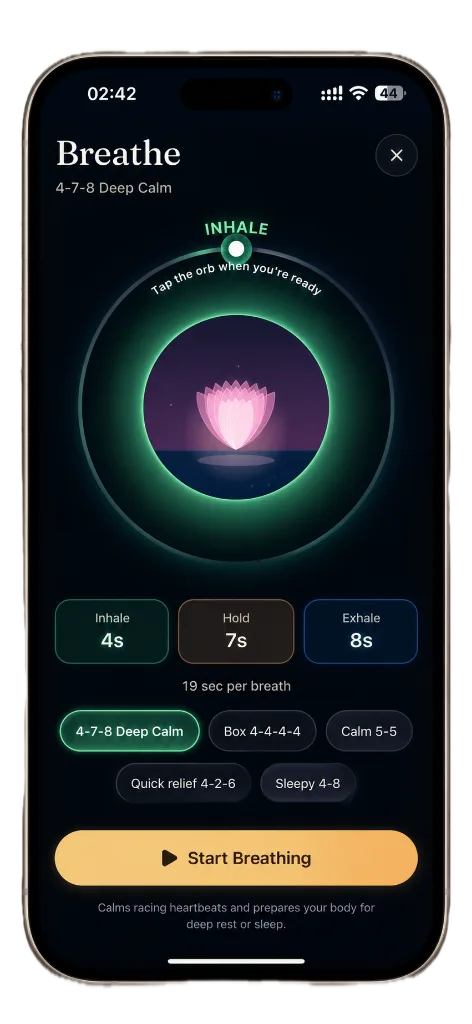
You can also use our free breathing timer to pace the breaths quietly on your screen.
You do not need to figure out your whole life while you breathe. Just follow the air moving in and out of your chest. Even sixty seconds of this can take the sharp edge off a stressful moment.
2. Put on soft, familiar music
Music has a way of slipping past noisy thoughts and speaking straight to your body. When your head feels loud, a calm melody can act like a soft blanket.
Try putting on some gentle piano, slow acoustic guitar, low-fi beats, or ambient nature sounds like rainfall, sea waves, or distant birdsong. The free sleep sounds mixer lets you blend soft rain and night sounds together if you need something quiet in the background.
If you can, put your phone face-down and just listen for a track or two. Don't try to answer messages or clean the room at the same time. Just let the music fill the space.
It does not have to be instrumental, either. Sometimes an old, comforting song that carries fond memories is the exact reminder you need that warmth and joy still exist.
The goal isn't to run away from your problems forever. It’s just to give your mind a quiet pocket of air so you can return to things with a steadier head.
3. Step out of the room for five minutes
When stress piles up, our instinct is often to push harder—to keep typing, keep arguing, or keep staring at the screen until we fix it. But pushing through a foggy, overwhelmed mind rarely helps.
Taking a short break isn’t giving up or being lazy. It is simply letting your engine cool down.
If you can, step away from whatever is causing the friction:
- Walk into another room.
- Stand by an open window.
- Step outside onto the porch or balcony.
- Splash a little cool water on your face.
During these few minutes, resist the urge to open social media or check your inbox. Constant scrolling keeps your brain on high alert. Give yourself five true minutes of quiet away from the noise, then decide what to do next.
4. Bring your mind back to where your feet are
Most of our stress lives in two places: the past (replaying conversations, regretting mistakes) or the future (imagining worst-case scenarios and worrying about what might happen).
Mindfulness sounds complicated, but it simply means coming back to right now—the only moment you can actually do anything about.
A classic, grounding way to do this is the 5-4-3-2-1 grounding exercise:
- 5 things you can see: Look around and notice small, plain details—a shadow on the wall, a pen on the desk, the grain of wood.
- 4 things you can physically feel: The chair beneath your legs, your socks against your feet, a cool breeze, the fabric of your shirt.
- 3 things you can hear: The hum of a refrigerator, traffic outside, your own breath.
- 2 things you can smell: Fresh coffee, rain, the soap on your hands.
- 1 thing you can taste: A sip of water, or the lingering taste of mint or tea.
You don't need a meditation cushion to practice this. You can do it while washing dishes, sipping tea, or waiting at a red light. It simply brings your wandering mind back into the room.
5. Unclench and move your body gently
Stress doesn't stay in your head; it settles directly into your muscles. You might not notice until your neck aches, your shoulders are glued to your ears, or your teeth are grinding together.
You don't need to do a sweaty, exhausting workout to release that pent-up energy. Gentle movement is often much better:
- Roll your shoulders backward three times, then let them drop.
- Open your mouth wide to release your jaw, then let your tongue rest loosely.
- Stretch your arms overhead and wiggle your fingers.
- Take a slow, ten-minute walk around the block or down the hallway.
When you spend hours sitting at a desk or staring at a screen, make little movement breaks part of your day. It reminds your body that it isn't trapped.
6. Get the heavy thoughts out onto paper
Stress feels much bigger when it’s bouncing around in your head like an echo chamber. When everything feels tangled, writing helps untie the knots.
Grab a notebook or a blank scrap of paper. Don't worry about neat handwriting, grammar, or making sense. Just write down what hurts, what worries you, and what is making you tired. Nobody else ever has to read it. (If you want a simple way to start, read our guide on how to start a mood journal).
If you don't know where to start, answer these four simple questions:
- What is bothering me the most right now?
- Is there anything in this situation I can actually control today?
- What is one small, realistic step I can take?
- What can I safely put down and leave for tomorrow?
Writing things down turns vague, terrifying fears into plain words on a page. And once a problem is on paper, it is much easier to manage.
7. Step outside and touch some nature
There is something deeply steadying about being around trees, grass, and open sky. Nature is never in a rush, yet everything gets done.
If you can, go outside for just ten minutes:
- Walk to a nearby park or garden.
- Sit on a bench and feel the warmth of the sun on your face.
- Watch the clouds drift or look up at the branches of a tree.
- Leave your phone in your pocket and just listen to the breeze.
If you can’t get outside today, you can still bring a little calm inside. Water a houseplant, open a window to let fresh air circulate, or even look out at the sky for a minute or two. Connecting with the world outside reminds you that life is bigger than whatever is stressing you today.
8. Share the weight with someone you trust
You were never meant to carry everything alone.
When we feel overwhelmed, it is easy to pull away from people. We tell ourselves that we don’t want to be a burden, or that nobody will understand. But keeping everything bottled up only makes the loneliness heavier.
Send a short text to a close friend, your partner, a sibling, or anyone who makes you feel safe:
"Hey, things have been feeling a bit heavy lately. Do you have a few minutes to talk or just hang out?"
You don't have to ask them to solve your problems, and they don't need to give you advice. Often, just having someone listen, nod, and say "I hear you, and that sounds really hard" is enough to help you feel lighter.
If life has felt unmanageable for weeks, or stress is getting in the way of eating and sleeping, reaching out to a therapist or counselor is one of the kindest, bravest things you can do for yourself.
9. Ease up on coffee and protect your sleep
Your physical body has a massive impact on your emotional resilience. When your body is running on empty, small problems feel like catastrophes.
Keep an eye on two things in particular:
- Caffeine: Too many cups of coffee, energy drinks, or strong tea can mimic anxiety—causing a racing heartbeat, shaky hands, and restlessness. If you’re already feeling anxious, try switching to herbal tea or water, especially after midday.
- Sleep: When you're tired, your brain loses its ability to regulate emotions smoothly. Give yourself a gentle runway before bed. Dim the lights, put your phone across the room 30 minutes before sleep, and give your mind permission to clock out. (For a gentle evening habit, see our guide to winding down before bed).
Taking care of your basic needs—drinking a glass of water, eating a warm meal, and resting when you are worn out—is not a luxury. It is basic maintenance.
10. Try tensing and releasing your muscles
Sometimes you carry so much physical tension that you forget what feeling relaxed actually feels like.
Progressive muscle relaxation is a simple, physical trick to reset your body:
- Sit comfortably or lie back in bed.
- Squeeze your hands into tight fists for 5 seconds. Feel the tension.
- Open your hands and let go completely. Notice the warm, tingling difference.
- Now scrunch your shoulders up tight toward your ears for 5 seconds. Then let them drop completely.
- Do the same with your legs, curling your toes tight for 5 seconds, and then releasing.
As you let go of each muscle, take a slow out-breath and feel the heaviness sink into the mattress or chair. This is especially comforting if you find yourself tossing and turning at night.
11. Go easy on yourself and drop the need to be perfect
So much of our daily stress doesn't come from external demands—it comes from the harsh voice inside our own heads.
We expect ourselves to be productive every minute, never make a mistake, keep everyone pleased, and juggle a hundred responsibilities without breaking a sweat. And when we drop a ball, we beat ourselves up.
Remember: you are human, not a machine.
You are allowed to have off days. You are allowed to be tired. You are allowed to leave the dishes in the sink tonight if you have nothing left to give.
Instead of saying, "I should be handling this better," try telling yourself:
"I am doing the best I can with the energy I have right now, and that is enough."
Treat yourself with the same gentleness and patience you would offer your best friend if they came to you exhausted.
12. Build little pockets of calm into your day
Peace of mind isn't something you only reach for when you're in the middle of a crisis. It works best when you weave tiny, quiet pauses throughout your day.
Here is what that can look like without taking much time:
- In the morning: Don't grab your phone the second your eyes open. Take two slow breaths, drink a glass of water, and pick just one important thing to focus on today. (See our slow morning routine guide for ideas).
- In the middle of the day: When switching between tasks, pause. Stretch your neck, step outside for fresh air, or listen to a quiet song before jumping into the next thing.
- In the evening: Write down your to-do list for tomorrow so it isn't buzzing in your head all night. Turn off bright overhead lights.
- At bedtime: Keep the bedroom cool and dim. Remind yourself: "Today is done. Whatever didn't get finished can wait until tomorrow."
You don't have to follow this like a strict schedule. Even choosing one small habit makes a noticeable difference over time.
What to do right now: your quick-action compass
If you are feeling completely overwhelmed right this second, you do not need to read this entire guide. Choose the single tool below that matches what your body needs most right now:
- If your heart is pounding or chest feels tight: Don't try to meditate. Take two physiological sighs—a double inhale through your nose followed by a long, slow sigh out through your mouth to immediately engage your vagus nerve.
- If you are sitting at your desk or in a chair: Follow our step-by-step 5-minute midday reset to drop your shoulders, steady your breathing, and pick one single task.
- If you feel frozen, numb, or stuck on the sofa: Your nervous system is in tonic immobility. Read our guide on how to unfreeze from anxiety using gentle somatic shaking to release trapped adrenaline.
- If you just stepped through the front door after an exhausting day: Give yourself a quiet buffer with our 10-minute emotional reset before you jump into evening chores.
Remember: the point is not to fix your entire life in the next sixty seconds. The point is simply to help your body feel steady enough to take the next gentle step.
A quiet reminder to take with you
You do not have to earn the right to rest.
You don't need to finish every task on your list, reply to every message, or solve every problem before you allow yourself to take a breath and be at peace.
Life will always have busy seasons and noisy days. But in the middle of it all, you can always choose to stop for sixty seconds, soften your shoulders, take a long exhale, and remind yourself:
You only have to handle this one moment right now.
Common questions
What should I do if my stress feels too big to calm down?
Do not fight the feeling or force yourself to be perfectly calm right away. Start with something small and physical: splash cold water on your face, press your feet flat onto the floor, or take three breaths with a longer exhale. If you feel persistently overwhelmed, please consider speaking with a doctor or counselor.
Does deep breathing actually help with stress?
Yes. When your out-breath is longer and softer than your in-breath, it stimulates your vagus nerve and activates your parasympathetic nervous system. This naturally lowers your heart rate and signals your body that you are safe right now.
What if I get distracted during mindfulness exercises?
That is completely normal. Mindfulness is not about having an empty, thought-free mind. It is simply noticing that your mind wandered and gently bringing your attention back to where your feet are, without criticizing yourself.
How can I remember to take breaks before I burn out?
Tie a short pause to an existing habit you already do every day: taking three slow breaths before opening your morning email, stepping outside for two minutes after lunch, or rolling your shoulders when you shut down your laptop.
Try this in Aama
Breathing exercises, sleep sounds and a mood journal, in one quiet app for your phone. No ads inside.
Feeling unsafe? Get help now
Related guides
Waking up with a racing heart at 3 AM
Why sudden nighttime panic happens, why you aren't in danger, and what to do in the dark when your heart is pounding.
The sour candy trick: how intense senses break an anxiety loop
Why keeping an intensely sour candy, a lemon slice, or a strong mint in your pocket is one of the most effective ways to short-circuit panic.