Waking up with a racing heart at 3 AM
Not medical advice.
5 min read
It is 3:15 AM. You were asleep just moments ago, but suddenly your eyes fly open.
Your heart is hammering against your chest wall like a trapped bird. Your skin feels clammy, your breath is shallow, and your mind immediately races to the worst possible conclusion: Something is wrong with me.
Waking up in a state of terror in the dark is one of the most frightening experiences a person can have.
The first and most important thing you need to know right now is this: You are not dying, and your heart is not broken. Your alarm system simply went off by mistake.
Why this happens around 3 or 4 AM
Waking up with a pounding pulse in the small hours of the morning feels random, but it is actually tied to your body’s daily hormonal clock:
- The natural cortisol surge: Around 3:00 to 4:00 AM, your liver and adrenal glands naturally begin trickling cortisol and adrenaline into your bloodstream to help you wake up hours later. When you are going through a stressful period, your nervous system is on hair-trigger alert. That tiny, normal rise in morning hormones gets misinterpreted as an emergency, triggering an adrenaline surge.
- Nighttime silence amplifies everything: During daylight, conversations and room noise distract your attention. At 3 AM, there is no sound and no light. Every heartbeat sounds ten times louder, and small worries feel like catastrophes.
- The sleep-cycle transition: As your brain transitions from deep slow-wave sleep into lighter REM sleep, your heart rate naturally fluctuates. If you wake up right during this shift, you become hyper-aware of your pulse.
What to do right now in the dark
If you are reading this while sitting in bed with a fast pulse, follow these quiet steps:
1. Stop checking the clock
Constantly checking the time only creates panic-math: "It's 3:30. If I don't sleep now, I will be exhausted tomorrow." Turn your phone face-down. You cannot force sleep, and stressing about tomorrow only pumps more adrenaline into your veins.
2. Put both feet flat on the floor
Sit up and let your feet rest firmly on the cool floor or rug. Feel the ground beneath your heels. Tell your body: "I am not in danger. I am safe in my bedroom, and this is just an adrenaline false alarm."
3. Take a sip of cold water
Keep a glass of water by your bed. Taking three slow sips forces your throat to swallow, which physically interrupts rapid, shallow breathing and activates the vagus nerve.
4. Lengthen your out-breath
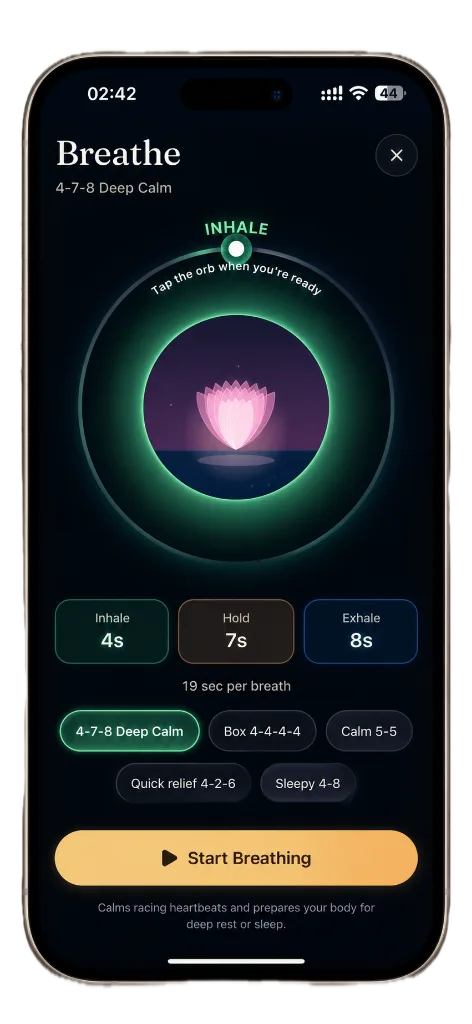
Inhale through your nose for 4 seconds, and breathe out slowly through your lips for 7 or 8 seconds. Do not try to force deep breaths. Just make sure the breath out is twice as long as the breath in.
5. If you are awake after 20 minutes, get up
Do not lie in the dark wrestling with your pillow. Get out of bed, move to a comfortable chair, wrap yourself in a blanket, and read a few pages of a quiet, ordinary book under a warm lamp.
You can also turn on steady background sound to give your ears something to rest on. The free sleep sounds mixer lets you layer gentle rain and singing bowls with an automatic timer that fades out once you drift off.
Once your heart rate softens and your eyelids feel heavy again, crawl back into bed.
The night is still long. Be patient with your tired body. (For a gentle evening wind-down, see our guide on how to calm racing thoughts at night).
Common questions
Why does my heart beat so fast when I wake up in the middle of the night?
Between 3:00 AM and 4:00 AM, your body naturally begins producing cortisol to prepare for morning. If you are chronically stressed, this normal hormone rise can trigger an adrenaline spike, causing you to wake up suddenly with a fast pulse.
Is waking up with a racing heart dangerous?
In the vast majority of cases, nocturnal panic attacks are not medically dangerous—they are an adrenaline false alarm. However, if you experience sudden chest pain radiating to your jaw or arm, shortness of breath, or fainting, you should seek medical evaluation.
Should I stay in bed trying to force myself back to sleep?
No. Tossing and turning in frustration teaches your brain that your bed is a place of anxiety. If you haven't settled after 15 to 20 minutes, get out of bed and sit somewhere dim until your pulse slows down.
Try this in Aama
Breathing exercises, sleep sounds and a mood journal, in one quiet app for your phone. No ads inside.
Feeling unsafe? Get help now
Related guides
The sour candy trick: how intense senses break an anxiety loop
Why keeping an intensely sour candy, a lemon slice, or a strong mint in your pocket is one of the most effective ways to short-circuit panic.
How to reset after an overwhelming day
A gentle 10-minute pause for when your brain feels buzzing, your body is tight, and sleep alone won't quiet the day.