How to reset after an overwhelming day
Not medical advice.
7 min read
Some days leave you exhausted in a way that sleep alone cannot fix.
You might have spent hours staring at screens, managing other people's emergencies, commuting through traffic, or swallowing your words in difficult conversations. By the time you finally step through your front door or shut your laptop, your battery is completely drained.
Yet, your head is still spinning. It replays what you should have said, worries about tomorrow's deadlines, and buzzes with an anxious hum that won't turn off.
Jumping straight from that kind of day into making dinner or trying to fall asleep rarely works. What your nervous system needs is a landing strip—a brief, quiet buffer between the demands of the day and the rest of your evening.
This simple 10-minute emotional reset asks very little of you. No equipment, no forced positivity, and no pressure to feel completely peaceful by the end. Just ten minutes to catch your breath and remember that you are a human being, not an engine.
What an emotional reset actually is
An emotional reset is not about pretending everything is fine. It isn't meditation in the traditional sense, and it won't magically solve your problems before tomorrow morning.
Think of it as setting down a heavy backpack.
When you carry a forty-pound pack all day, taking it off doesn't make the journey disappear. But it gives your shoulders a moment to breathe so you aren't carrying that dead weight to the dinner table or into bed with you.
It is a small boundary you give yourself: a quiet declaration that today is done, and whatever didn't get finished can wait until the morning.
The 10-minute reset, step by step
Find a comfortable spot to sit—on your couch, the edge of your bed, or even in your parked car before walking inside. Put your phone face-down.
Minute 1: Stop and arrive
Before reaching for another screen, opening social media, or jumping into household chores, give yourself sixty seconds to just stop moving.
Rest your hands on your lap. Feel the weight of your feet resting flat on the floor.
Look around the room and notice three plain things:
- The texture of the blanket or chair beneath you.
- The light coming through the window or a lamp on the table.
- The quiet ambient hum of the room around you.
You don't have to fix anything right now. For the next ten minutes, nobody needs anything from you. Allow yourself to actually arrive in the room.
Minutes 2–3: Let your body physically uncoil
An overwhelming day leaves invisible knots all over your body. Without noticing, you've probably spent the last six hours holding your breath, clenching your teeth, and pulling your shoulders up toward your ears.
Take a quick, gentle scan:
- Your jaw: Separate your teeth and let your tongue fall loosely away from the roof of your mouth.
- Your shoulders: Roll them backward once, then let them drop completely down.
- Your hands: Open your fists, stretch your fingers wide, and let them rest softly.
- Your belly: Stop holding your stomach in. Let your belly go soft and round.
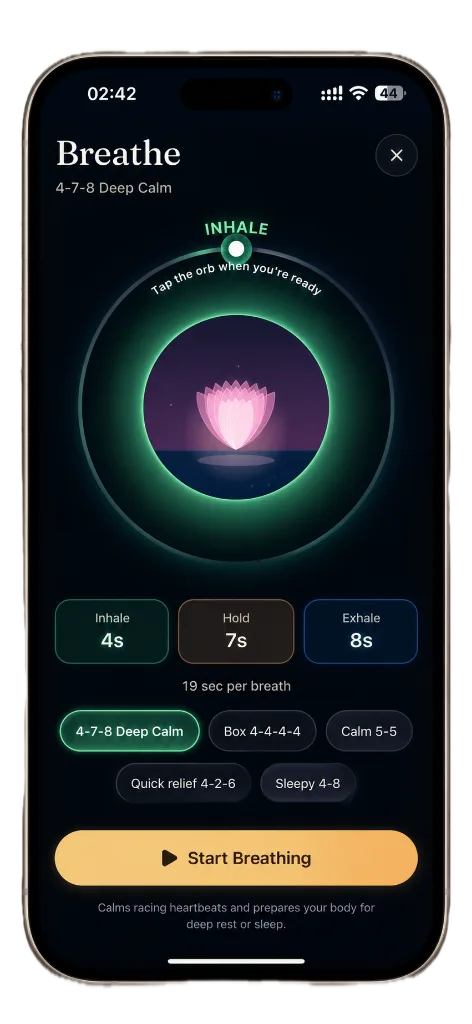
Now take three slow breaths. Inhale gently through your nose, and let the exhale be long, slow, and unhurried through your mouth. (If you want a steady rhythm to follow, open our free breathing timer for a couple of cycles).
Minute 4: Give the feeling an honest name
When you're overwhelmed, everything feels like one giant, tangled knot of tension. But "stressed" is often just a blanket term covering up what is really hurting.
Ask yourself quietly: What is actually weighing on me right now?
Fill in one of these simple blanks:
- "I'm exhausted because I had to hold too much today."
- "I'm frustrated because that meeting felt unfair."
- "I'm lonely and I wish someone had checked on me today."
- "I'm scared that I won't get everything done tomorrow."
You don't need to write an essay or fix the feeling. Just saying it to yourself—without judging yourself for feeling that way—takes away half the confusion. It gives your mind permission to feel tired after a hard day.
Minutes 5–6: Put down what can safely wait
An overwhelmed mind treats every single thought like a five-alarm fire. It tells you that the unread email, the messy laundry, and tomorrow's presentation all require your urgent attention right now.
They don't.
Take two minutes to separate what genuinely needs you tonight from what is just noisy anxiety.
If it helps, write down two small notes on a scrap of paper (or in our mood journal guide):
- What can wait for tomorrow morning:
- Replying to non-urgent messages.
- Replaying conversations you cannot change.
- Solving problems that aren't happening until next week.
- The one small thing I will do tonight:
- Eat a warm meal.
- Wash my face.
- Set an alarm and go to sleep.
Pick just one small thing for the rest of tonight. Everything else stays on the paper. The paper will remember it for you; your head doesn't have to carry it anymore.
Minutes 7–8: Give yourself one tiny comfort
You do not have to earn the right to rest by checking off every item on your list.
Give your body one tangible, comforting sensation:
- Pour a tall glass of cold water and drink it slowly.
- Peel off your work clothes or tight socks and slip into your softest clothes.
- Splash warm water on your face to wash away the grit of the day.
- Open a window and take three breaths of crisp, fresh air.
- Step outside and look at the sky for two minutes.
Pick something plain and effortless. The goal isn't to be productive at self-care—it’s just to feel comfortable in your own skin again.
Minutes 9–10: Choose your next gentle step
Before you stand up and return to the evening, ask yourself one final question:
What would make the next hour feel a little more manageable?
Your answer might be:
- Sitting quietly on the sofa without any background noise.
- Making a simple bowl of soup or toast.
- Listening to quiet music or our sleep sounds mixer.
- Heading straight to bed, even if it is earlier than usual.
Set one gentle boundary for your night. Tell yourself:
"Tonight, I will do only what is necessary, and I give myself permission to let the rest wait."
Take one last long exhale. The reset is complete.
What if your head is still noisy?
Sometimes, an overwhelming day is so loud that a 10-minute pause won't completely quiet the storm. You might finish these steps and still feel anxious, sad, or wound up.
That does not mean you failed.
Some days are simply heavy, and the body takes time to process that weight. If you're still feeling unsettled, try this:
- If your thoughts are still racing in loops: Don't fight them in bed. Sit in a dim room with a blanket and try our calm racing thoughts at night guide.
- If your body feels restless or fidgety: Don't force yourself to sit still. Go for a slow, ten-minute walk around the block, or do a gentle neck stretch.
- If you feel alone: Send a short text to someone you trust: "Today was a really heavy day. Mind if I just say hi?"
- If you feel disconnected from reality: Try the 5-4-3-2-1 grounding exercise to bring your senses firmly back into the room.
(And if you find that every day feels heavy, or that overwhelm is making it hard to eat, sleep, or feel safe, please consider speaking with a mental health professional. Reaching out for human support is one of the bravest things you can do).
A quiet reminder to carry into tonight
You do not have to turn every difficult day into a productivity lesson. You don't need to optimize your evening, and you don't need to fix tomorrow before today has even finished.
Tonight, your only job is to be gentle with yourself.
Take things one breath, one glass of water, and one step at a time.
You are allowed to end the day without having everything figured out.
Common questions
What if I finish the 10 minutes and still feel stressed?
That is completely okay. Ten minutes is not a magic wand, and some days are genuinely hard. The goal was never to erase the day; it was simply to give yourself a soft landing strip so you aren't carrying the noise straight into your bed.
When is the best time to do an emotional reset?
Right in the doorway between work and your evening: when you shut down your laptop, step out of your car, or walk into your home. It marks a clear border between the world's demands and your own peace.
What if I don't have a quiet room to myself?
You don't need absolute silence or a meditation cushion. You can do this sitting in your parked car, in a quiet corner of the kitchen, or while sipping a glass of water on the sofa.
How does unclenching the body help with mental stress?
When you have an overwhelming day, your nervous system braces for impact by tightening your jaw, neck, and shoulders. Consciously dropping your shoulders and taking a slow exhale sends a physical signal back to your brain that the immediate threat has passed.
Try this in Aama
Breathing exercises, sleep sounds and a mood journal, in one quiet app for your phone. No ads inside.
Feeling unsafe? Get help now
Related guides
Waking up with a racing heart at 3 AM
Why sudden nighttime panic happens, why you aren't in danger, and what to do in the dark when your heart is pounding.
The sour candy trick: how intense senses break an anxiety loop
Why keeping an intensely sour candy, a lemon slice, or a strong mint in your pocket is one of the most effective ways to short-circuit panic.