The physiological sigh: the fastest way to stop an anxiety spike
Not medical advice.
4 min read
When anxiety suddenly spikes—your heart thuds against your ribs, your palms go cold, and a wave of heat washes over your neck—telling yourself to "just calm down" almost never works.
In fact, trying to talk yourself out of panic often makes you panic more, because your logical brain is currently offline. Your ancient nervous system has taken the wheel, and it thinks you are in physical danger.
To calm down quickly, you cannot argue with your mind. You have to speak directly to your body in a physical language it understands.
The single fastest, most reliable tool discovered by neuroscientists to stop this reaction is called the physiological sigh.
You do not need an app, a timer, or a quiet room. You can do it at your desk, on a crowded bus, or standing in line at the grocery store.
How to do it
It takes less than ten seconds:
- Take a normal breath in through your nose. (Fill your lungs about 80% of the way).
- Without exhaling, take a second, sharp little "top-off" sniff through your nose. (Pack in that last bit of air until your chest is full).
- Let the breath fall out of your mouth slowly and softly. Don't force it; just let it sigh out in an unhurried, gentle wave until your lungs are empty.
Repeat this two or three times.
That is all. Notice how your shoulders drop on the third exhale.
Why this works when other breathing advice fails
Many people find standard "deep breathing" frustrating during a panic attack. When you are already hyperventilating, taking huge gulps of air can make you feel dizzy or suffocated.
The physiological sigh works differently because of the tiny mechanics of your lungs:
- It pops open your lungs: When you feel stressed or shallow-breathed, millions of microscopic air sacs in your lungs (called alveoli) collapse like tiny popped balloons. The second sharp sniff forcefully re-inflates them.
- It dumps excess carbon dioxide: Because all those air sacs are suddenly open, your long exhale unloads carbon dioxide much faster than a standard breath.
- It triggers your heart's brake pedal: When your out-breath is longer than your in-breath, your diaphragm moves upward, giving your heart slightly less room. To compensate, a cluster of nerves called the sinoatrial node signals your brain, which activates the vagus nerve and mechanically slows down your pulse.
This isn't positive thinking. It is human biology.
When to reach for this
Keep this tool in your back pocket for moments when life hits you sideways:
- Right after an email or phone call that makes your stomach drop.
- While sitting in traffic when you feel trapped and claustrophobic.
- In the middle of an argument when you feel your voice shaking.
- In bed at night when your heart is pounding for no apparent reason.
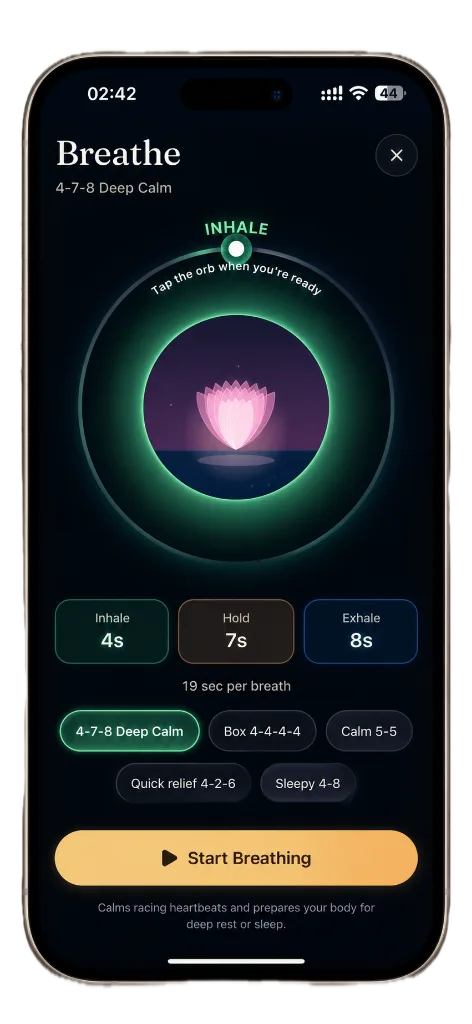
Whenever your mind starts racing ahead of you, give your body two physiological sighs. Let the physical brake slow you down, and then take your next step. (For a gentle visual pace, you can also use our free breathing timer to keep your breath steady).
Once your pulse has steadied, if you want a sustained practice, try box breathing for clear daytime focus or 4-7-8 breathing for deep evening relaxation.
Common questions
How many times should I do the physiological sigh?
Usually two or three sighs in a row are enough to feel your heart rate settle. You can repeat it whenever you feel another wave of panic or tension rising.
Why two breaths in instead of just one deep breath?
The second short sniff pops open tiny collapsed air sacs in your lungs (called alveoli). This lets your body dump carbon dioxide on the long exhale, which triggers your vagus nerve to slow down your heart.
Can I do this in public without people noticing?
Yes. You don't have to make a loud sound. Just take a normal inhale through your nose, top it off with a quiet little sniff, and let the breath slip silently out of your mouth.
Try this in Aama
Breathing exercises, sleep sounds and a mood journal, in one quiet app for your phone. No ads inside.
Feeling unsafe? Get help now
Related guides
Waking up with a racing heart at 3 AM
Why sudden nighttime panic happens, why you aren't in danger, and what to do in the dark when your heart is pounding.
The sour candy trick: how intense senses break an anxiety loop
Why keeping an intensely sour candy, a lemon slice, or a strong mint in your pocket is one of the most effective ways to short-circuit panic.