Why anxiety makes you freeze (and how to shake it out)
Not medical advice.
4 min read
Most people think of anxiety as a state of frantic motion: pacing the floor, talking fast, or a pounding heart.
But there is another, lesser-known side of anxiety that looks completely different: the freeze state.
You sit on the sofa staring at your phone, unable to get up. You have a mountain of important tasks to do, but your limbs feel like concrete. You aren't relaxing, and you aren't enjoying yourself. Inside, your thoughts are screaming at you to get moving, but your body simply refuses to cooperate.
If this happens to you, stop beating yourself up. You are not lazy, unmotivated, or broken.
You are experiencing an ancient nervous system response called tonic immobility. And the way out isn't through willpower—it's through movement.
Why your body freezes
When your brain perceives overwhelming stress, it doesn't just choose between fight or flight. If it decides that fighting won't work and running away isn't possible, it triggers the oldest survival mechanism in nature: freeze.
Think of a deer playing dead when it is caught by a predator. By shutting down its muscles and slowing its breathing, the animal protects itself from pain and waits for the danger to pass.
In modern life, you aren't running from lions. But when you are hit with overwhelming bills, exhausting work pressure, or chronic emotional strain, your nervous system can treat modern stress just like a physical trap. It shuts down your engine to protect you.
The problem is that all that trapped adrenaline stays locked inside your muscles, leaving you feeling numb, stiff, and foggy.
How to shake the freeze out of your body
In nature, if an animal survives a predator attack, the first thing it does is stand up and violently shake its entire body from head to tail. This involuntary trembling (called neurogenic release) dumps the adrenaline surge and tells the brain: "The danger is gone. You can turn the lights back on."
Humans have the exact same biology, but our culture teaches us to sit stiffly and hold everything in.
Here is how you can use somatic shaking to unfreeze:
1. Shake out your hands and wrists (30 seconds)
Stand up (or sit on the edge of a chair). Hold your hands in front of you and shake your wrists loosely, as if you are trying to shake drops of water off your fingertips. Let your fingers go completely limp.
2. Bounce on your heels (30 seconds)
Stand with your feet shoulder-width apart. Lift your heels an inch off the floor, then drop them back down. Let the gentle thud vibrate up through your calves, knees, and hips. Keep your knees soft and your jaw loose.
3. Roll your shoulders and make a sigh
Roll your shoulders backward in big, exaggerated circles. As you roll them down, let out a loud, vocalized sigh or hum: "Huuuuuuh." The vibration in your chest stimulates the vagus nerve and breaks the physical stiffness in your throat.
4. Pick one tiny, microscopic next step
Once you stop shaking, don't try to tackle your entire to-do list. The freeze will just come right back. Pick one ridiculously small action:
- Walk into the kitchen and drink a glass of water.
- Put one dish into the sink.
- Open one document and read just the title.
You don't need to conquer your whole life right now. Breaking an anxiety freeze isn't about being productive—it is simply about reminding your body that you are safe to move again. (For more gentle recovery steps, see our guide to resetting after an overwhelming day).
Common questions
What is the difference between being lazy and being in an anxiety freeze?
Laziness is a choice to enjoy doing nothing. An anxiety freeze feels like you desperately want to move or start your tasks, but your body physically feels leaden, stuck, and numb. It is an involuntary nervous system defense, not a character flaw.
Why does shaking your body help with anxiety?
When wild animals survive an attack by a predator, the very first thing they do is violently shake their entire bodies to discharge excess stress hormones and signal to their brain that the threat is over. Humans have the exact same neurogenic release mechanism.
How long should I shake my body?
Even 60 to 90 seconds of gently shaking your hands, bouncing on your heels, or loosening your shoulders is enough to discharge trapped sympathetic energy and break a freeze state.
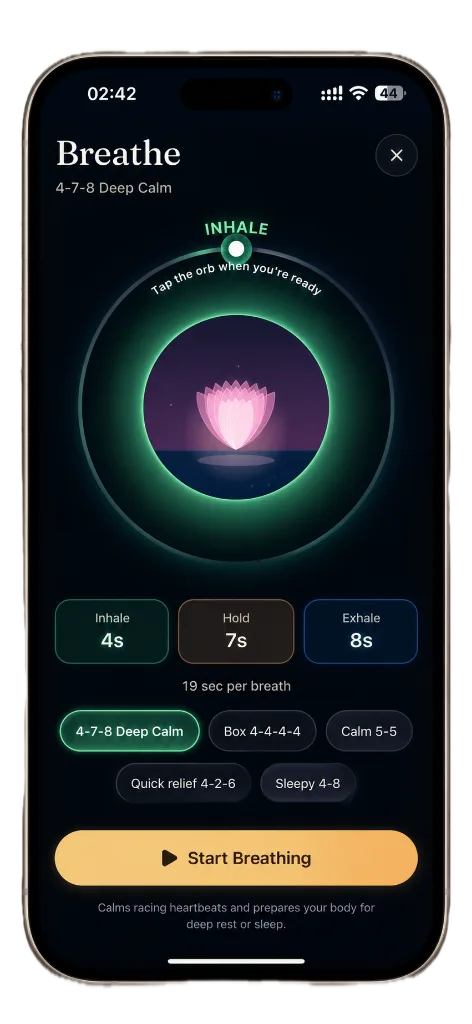
Try this in Aama
Breathing exercises, sleep sounds and a mood journal, in one quiet app for your phone. No ads inside.
Feeling unsafe? Get help now
Related guides
Waking up with a racing heart at 3 AM
Why sudden nighttime panic happens, why you aren't in danger, and what to do in the dark when your heart is pounding.
The sour candy trick: how intense senses break an anxiety loop
Why keeping an intensely sour candy, a lemon slice, or a strong mint in your pocket is one of the most effective ways to short-circuit panic.