Grounding techniques for anxiety: 7 ways to come back to the present
Not medical advice.
Published by Aama · Updated · 7 min read
Grounding means bringing your attention back to the present through your senses. Here is a quick-pick guide: find the line that matches your situation, and try the technique beside it.
Find your situation
| If you are... | Try | Time |
|---|---|---|
| Somewhere public, and want to be discreet | Feet on the floor, or describe the room | 1 min |
| Spiralling with "what if" thoughts | 5-4-3-2-1 | 2-3 min |
| Feeling numb, far away or unreal | Something strong: cold or a sharp taste | 1 min |
| Frozen, heavy or stuck | Gentle movement | 2 min |
| Wound up and can't focus | Name things in a category | 1-2 min |
| Lying in bed, mind busy | Describe the room by sound and touch | 3 min |
If you are in public
Feel your feet. Press both feet into the floor and notice the pressure and the temperature of the surface. Wiggle your toes inside your shoes.
Describe the room. Silently say plain facts: "I am sitting on a blue chair. The window is open. There is a cup on the table." Neutral facts are calming because they cannot be argued with.
If your mind is full of "what if"
Use the 5-4-3-2-1 exercise: name five things you can see, four you can feel, three you can hear, two you can smell and one you can taste. Go slowly. The full steps are in our 5-4-3-2-1 guide.
If you feel numb or unreal
When everything feels far away, a mild technique may not cut through, so choose a strong sensation:
- Cold: hold a cold drink or press a cool cloth to your face. Our guide to cold water for panic covers the safety points.
- Strong taste: a sour sweet, lemon or a strong mint. See the sour candy trick.
If you feel frozen or stuck
Move a little. Roll your shoulders, shake out your hands, stand up and walk to another room. Small movement is often easier to begin than a task. Why anxiety makes you freeze has a two-minute routine.
If you cannot settle
Pick a category and name as many as you can: colors, countries, animals, foods. It gives your mind a light puzzle that has nothing to do with the worry.
If you are lying awake
Without moving, notice where your body touches the bed, the weight of the blanket, the sounds in the house, the temperature of the air on your face. Name each one quietly. Let the details pile up.
Pair it with slow breath
Grounding and slow breathing work well together. After a technique above, take five slow breaths with a longer out-breath. The breathing exercises for anxiety comparison shows your options.
Grounding steadies a moment. It does not treat anxiety that keeps returning. If that is happening to you, a doctor or counselor can help. And if you ever feel unsafe, our helplines page is there at any hour.
Common questions
What is grounding?
Grounding is a set of simple exercises that bring your attention to the present moment, usually through your senses, so that anxious or overwhelming thoughts have less pull.
How long should I do a grounding exercise?
Usually one to five minutes. Stop when you feel a little steadier. You can repeat it as often as you like.
Does grounding work for panic attacks?
Many people find it helps them feel more present during or after a wave of panic. It is not a treatment for panic disorder, so if panic is frequent, speak to a doctor or mental health professional.
Try this in Aama
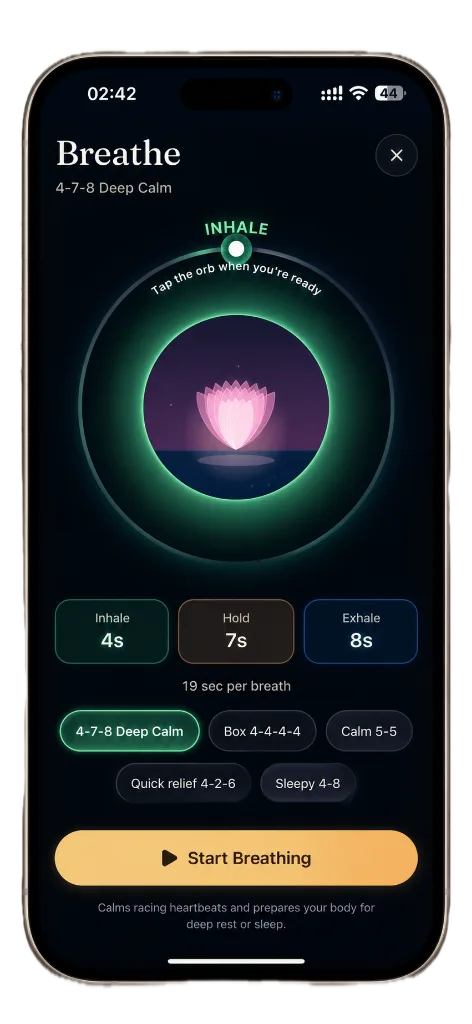
Breathing exercises, sleep sounds and a mood journal, in one quiet app for your phone. No ads inside.
Feeling unsafe? Get help now
Related guides
The 5-4-3-2-1 grounding exercise, step by step
Use your five senses to come back to the present moment. A simple, quiet exercise for when your mind is racing or spinning.
Cold water for panic: using your dive reflex to settle your body
How a splash of cold water on your face may help your heart rate settle during panic or overwhelm, three simple ways to try it, and important safety points.
The sour candy trick: using a strong taste to break an anxious spiral
How a strong taste like a sour sweet, lemon or mint can pull your attention into the present during anxiety, how to use it, and when it is not enough.
Why anxiety can make you freeze (and gentle ways to get moving)
Why stress and anxiety can leave you stuck on the sofa instead of panicking, how it differs from laziness, and simple movements and tiny steps to help you start again.