Breathing exercises for anxiety: 5 simple techniques you can do anywhere
Not medical advice.
Published by Aama · Updated · 8 min read
Breathing exercises are easy to mix up, since many sound similar. This page lines them up side by side so you can pick one in a few seconds.
Five techniques compared
| Technique | The pattern | Feels like | Best for | Difficulty |
|---|---|---|---|---|
| Physiological sigh | Two breaths in (second is a short top-up), one long breath out | A big release | A sudden spike of tension | Very easy |
| Box breathing | In 4, hold 4, out 4, hold 4 | Steady and even | Focus, nerves before a task | Easy |
| 4-7-8 | In 4, hold 7, out 8 | Slow, heavy, sleepy | Evenings and bedtime | Medium |
| Calm 5-5 | In 5, out 5 | Smooth and gentle | Beginners, anyone who dislikes holds | Very easy |
| Longer out-breath | In 4, out 6 | Light and flexible | Any moment, no counting to remember | Very easy |
Pick by the moment you are in
- Something just rattled you (a tense message, a near miss): the physiological sigh. Two or three rounds, about ten seconds each.
- You need to think straight (before a meeting, a call): box breathing, for one or two minutes.
- It is evening and your body is wired: 4-7-8, about four rounds.
- You find holds uncomfortable: calm 5-5 or the longer out-breath.
- You are somewhere you cannot be obvious: the sigh or the longer out-breath, which are the quietest.
Why a long out-breath keeps showing up
Almost every technique above has an out-breath that is the same length as, or longer than, the in-breath. A slow exhale is widely used to promote relaxation, and many people find it eases tension and slows the heart rate a little. The holds and counts mostly give your mind something to follow.
Try one right now
Pick whichever row appealed to you and do it for one minute. Notice two things afterwards: where your shoulders are, and how fast your breath feels. If nothing changed, try another row. People respond differently, and there is no prize for sticking with one.
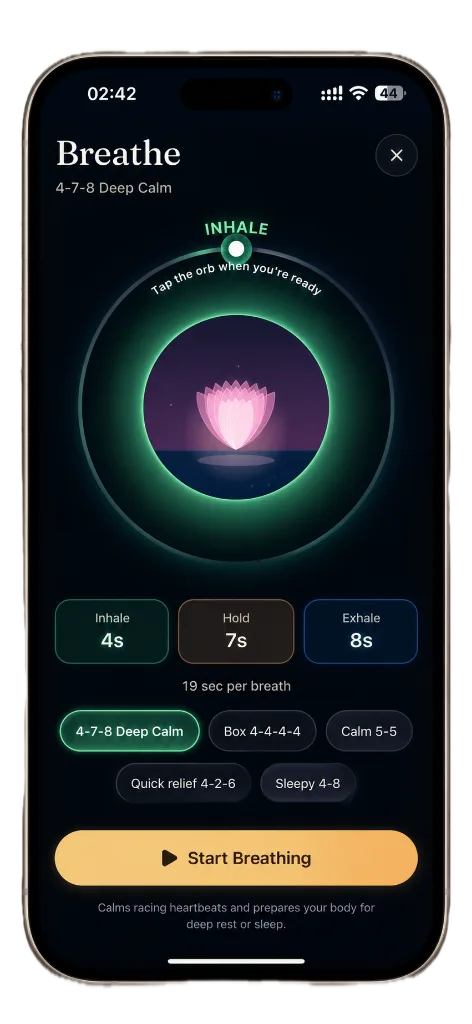
If you would like the pace shown to you, use our free breathing exercise timer, which has 4-7-8, box and calm 5-5 patterns.
Know your limits
Keep breaths gentle. If you feel dizzy, stop and breathe normally. People with asthma, heart or lung conditions, or who are pregnant should ask their doctor before trying breath holds.
For moments when breathing alone does not steady you, pair it with something for your senses. Grounding techniques for anxiety lists seven simple ones.
Common questions
Which breathing exercise is best for anxiety?
There is no single best one. The physiological sigh is quick for sudden spikes, box breathing is steady for focus, and 4-7-8 or a long out-breath suits the evening. Try a few and keep the one that feels easiest.
Can breathing exercises make anxiety worse?
For some people, especially at first, counting or holding the breath can feel uncomfortable. If it does, shorten the counts, skip the holds, or stop and breathe normally. Never force it.
How long should I practice?
One to three minutes is plenty. Little and often works better than one long session.
Try this in Aama
Breathing exercises, sleep sounds and a mood journal, in one quiet app for your phone. No ads inside.
Feeling unsafe? Get help now
Related guides
The physiological sigh: a quick breathing trick for an anxiety spike
How to do the physiological sigh, a two-breath pattern many people use to settle quickly when anxiety spikes, with a look at what research says and its limits.
Box breathing: a simple 4-4-4-4 guide
Learn box breathing step by step, with a short starter plan, common mistakes and when to adjust or stop.
4-7-8 breathing: a simple step-by-step guide
Learn the 4-7-8 breathing pattern in about a minute, with clear steps, common mistakes and when to stop.
Grounding techniques for anxiety: 7 ways to come back to the present
Seven simple grounding techniques for anxiety and overwhelm, from 5-4-3-2-1 to cold water and strong tastes, with guidance on how to choose and when to seek more help.