Cold water and ice: using your dive reflex to stop panic
Not medical advice.
5 min read
When a severe panic attack hits, your body feels like an overheated car engine.
Your thoughts are screaming that something is terribly wrong, adrenaline is flooding your bloodstream, and your pulse is hammering so fast you can feel it in your ears.
In those moments, meditating or repeating affirmations can feel completely impossible. What you need is an emergency circuit breaker—something that physically forces your nervous system to slam on the brakes.
Humans have an ancient, built-in biological mechanism called the mammalian dive reflex. And all it takes to trigger it is cold water.
What is the mammalian dive reflex?
All mammals, from seals and whales to humans, carry this evolutionary reflex.
When your face touches cold water while holding your breath, your brain instantly assumes you have submerged underwater. To keep you alive, it immediately triggers two involuntary physiological shifts:
- It drops your heart rate: Within 10 to 30 seconds, your pulse can drop by 10 to 25 beats per minute.
- It redirects blood flow: Blood pulls back from your extremities and rushes to protect your core organs and brain.
When you trigger this reflex during panic, it physically overrides the adrenaline spike. Your heart rate slows down because your biology literally won't allow it to stay racing underwater.
Three ways to use it right now
You don't need a cold plunge tub. Here are three simple ways to use cold to short-circuit panic:
1. The face-bowl dip (The strongest reset)
If you are at home:
- Fill a bowl with cold water and drop in a handful of ice cubes.
- Take a normal breath in.
- Submerge your face (especially the bridge of your nose, temples, and cheekbones) into the water for 15 to 20 seconds.
- Lift your head and breathe out slowly.
Almost immediately, you will feel the adrenaline surge lose its sharpest edge.
2. The ice pack over the cheekbones
If you don't want to submerge your face or you are wearing makeup:
- Grab a bag of frozen peas, an ice pack, or a wet paper towel wrapped around ice.
- Lean forward slightly, hold your breath, and press the cold pack firmly across your eyes, temples, and upper cheeks for 20 seconds.
- Your trigeminal nerve runs right across this part of your face; chilling this specific area triggers the exact same dive reflex.
3. The ice cube in your palm (Great for public)
If you are at work or in a restaurant:
- Excuse yourself to the restroom or ask for a glass of ice water.
- Take a single ice cube and hold it tightly in your bare hand until it hurts slightly from the cold.
- Shift the ice cube between your left and right palms, or press it against the inside of your wrists.
The intense, localized cold sensation shocks your sensory receptors. It pulls your brain away from internal doom-scenarios and forces it to focus on the freezing sensation in your hands.
After the cold: follow up with a breath
Cold water breaks the peak of the panic attack, but your body will still need a few minutes to settle completely.
Once you have used cold water:
- Pat your face dry with a soft towel.
- Sit down somewhere comfortable.
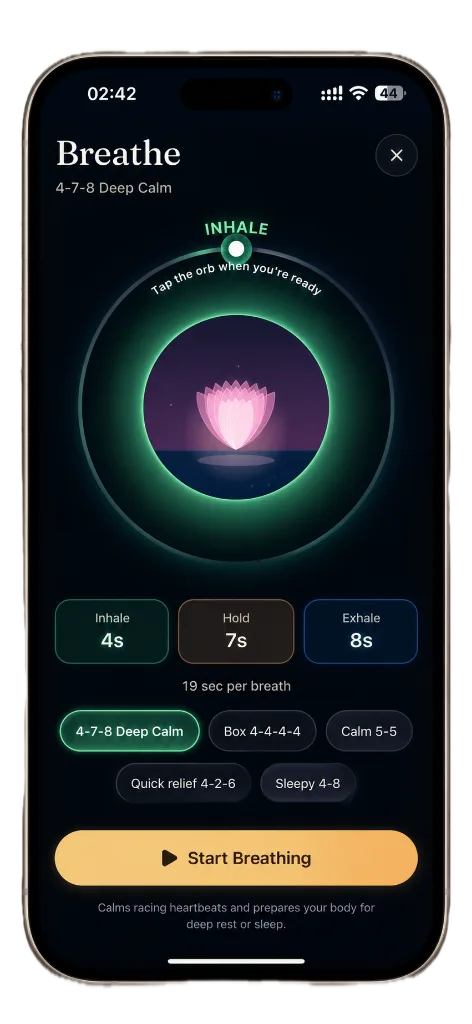
- Take three slow, long-exhale breaths (or follow our free breathing timer).
- Remind yourself: "The wave broke. My body is safe, and I am already coming down."
Cold water won't solve all your daily problems, but on the hardest days, it is the most reliable emergency brake you have. (If you want to know what to do next, see our guide on how to stay calm when you feel stressed).
Common questions
Why does cold water help with panic attacks?
Your body has an ancient biological survival mechanism called the mammalian dive reflex. Cold water on your face and cheekbones tells your brain you are diving into deep water, which physically forces your heart rate to plummet and conserves oxygen.
What if I am not near a bowl of ice water?
You can hold an ice cube in your palm, press a cold beverage can against your cheek, or simply run cold tap water over your wrists and splash your face in a bathroom.
Is this safe for everyone?
Yes, for most people. If you have a known heart condition or severe low blood pressure, stick to gentler methods like holding an ice cube rather than dipping your entire face in freezing water.
Try this in Aama
Breathing exercises, sleep sounds and a mood journal, in one quiet app for your phone. No ads inside.
Feeling unsafe? Get help now
Related guides
Waking up with a racing heart at 3 AM
Why sudden nighttime panic happens, why you aren't in danger, and what to do in the dark when your heart is pounding.
The sour candy trick: how intense senses break an anxiety loop
Why keeping an intensely sour candy, a lemon slice, or a strong mint in your pocket is one of the most effective ways to short-circuit panic.