Box breathing vs 4-7-8: which one should you use?
Not medical advice.
Published by Aama · Updated · 5 min read
Both patterns slow your breathing and give your mind something to count. They feel quite different, though. Here is a quick comparison to help you choose.
Side by side
| Box breathing | 4-7-8 breathing | |
|---|---|---|
| Pattern | In 4, hold 4, out 4, hold 4 | In 4, hold 7, out 8 |
| One round takes | 16 seconds | 19 seconds |
| Feels like | Steady, even, "squared" | Slow, heavy, a long release |
| Out-breath | Same as the in-breath | Twice as long as the in-breath |
| Holds | Two (after in, after out) | One (after in) |
| Good for | Focus, nerves before a task | Evenings, winding down |
| Can feel hard if | You dislike empty-lung holds | You find a 7-second hold too long |
Choose box breathing when...
- You want to feel level and focused, for example before a meeting or a hard conversation.
- You like an even rhythm that is easy to remember.
- You want something you can do at your desk with your eyes open.
Full steps: box breathing, a simple 4-4-4-4 guide.
Choose 4-7-8 when...
- It is evening, and you are trying to wind down for bed.
- You like the long, slow exhale.
- You are already sitting or lying down and do not need to stay alert.
Full steps: 4-7-8 breathing, step by step.
A two-minute trial you can do now
You can compare the two in under five minutes.
- Sit comfortably. Notice how your shoulders and breath feel before you start.
- Box breathing, one minute. Breathe in for 4, hold for 4, out for 4, hold for 4. About three or four rounds.
- Rest and breathe normally for thirty seconds.
- 4-7-8, one minute. In for 4, hold for 7, out for 8. About three rounds.
- Notice which one felt easier, and which left you more settled.
There is no right answer. Many people prefer box breathing in the day and 4-7-8 at night, and some prefer the same one all the time.
Using both in one evening
You do not have to choose. A gentle evening sequence could be:
- A few minutes after work: two minutes of box breathing to leave the day's focus behind.
- An hour before bed: dim the lights and put screens away.
- In bed: three or four rounds of 4-7-8, then let your breathing return to normal.
How each one is usually learned
Box breathing is often easier to learn because every step is the same length. 4-7-8 takes a few tries to get comfortable, because the hold is longer and the out-breath needs to be slow. If you lose count, simply start a new round. Practice little and often.
If neither feels right
Both are only shapes. You can bend them:
- Shorten the counts. Try 3-3-3-3 for box or 3-5-6 for 4-7-8.
- Drop the holds. Calm 5-5 breathing (in 5, out 5) or in 4 and out 6 work without them.
- Make the out-breath longer than the in-breath. This is the common thread in most relaxation breathing.
A simple way to decide
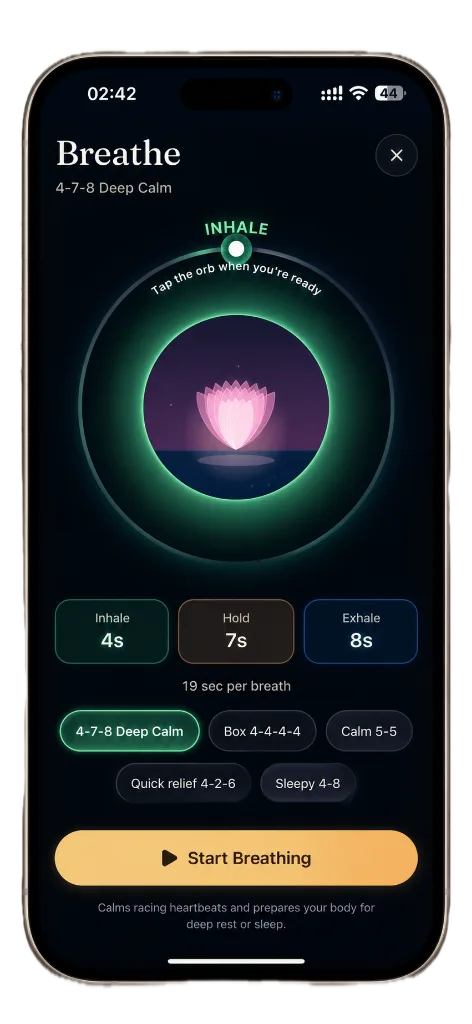
Try each for two minutes on different days, and notice how your shoulders and your breath feel afterwards. Keep the one that feels easier. Our free breathing exercise timer has both, plus calm 5-5, with a moving orb to follow.
A quick safety note
Keep breaths gentle. If you feel dizzy, stop and breathe normally. If you have asthma, a lung or heart condition, or you are pregnant, ask your doctor before trying breath holds. For a wider look, see breathing exercises for anxiety and breathing exercises for sleep.
Common questions
Is box breathing or 4-7-8 better for anxiety?
Neither is proven better. Many people find box breathing steadier in the daytime, and 4-7-8 more relaxing in the evening. Choose the one that feels more comfortable.
Can I use 4-7-8 breathing in the daytime?
Yes, but some people find the long hold and out-breath makes them sleepy or light-headed. If so, shorten the counts or use box breathing instead.
What if holding my breath feels uncomfortable?
Skip the holds. Calm 5-5 breathing (in for 5, out for 5) or a longer out-breath (in 4, out 6) have no holds at all.
Try this in Aama
Breathing exercises, sleep sounds and a mood journal, in one quiet app for your phone. No ads inside.
Feeling unsafe? Get help now
Related guides
Box breathing: a simple 4-4-4-4 guide
Learn box breathing step by step, with a short starter plan, common mistakes and when to adjust or stop.
4-7-8 breathing: a simple step-by-step guide
Learn the 4-7-8 breathing pattern in about a minute, with clear steps, common mistakes and when to stop.
Breathing exercises for anxiety: 5 simple techniques you can do anywhere
Five calm breathing exercises for anxiety, how each one works, when to use it, and how to choose. Includes the physiological sigh, box breathing, 4-7-8, and more.
Breathing exercises for sleep: gentle techniques for bedtime
Easy breathing exercises to help you wind down for sleep, including 4-7-8, a longer out-breath and calm 5-5 breathing, plus how to build them into a bedtime routine.