Breathing exercises for sleep: gentle techniques for bedtime
Not medical advice.
Published by Aama · Updated · 7 min read
Instead of a single technique, this is a gentle seven-night plan. Each night is five minutes or less. You do not need to be perfect, and you can repeat any night if you like.
The plan at a glance
| Night | What to do | How long | Notes |
|---|---|---|---|
| 1 | Just notice your breathing, no counting | 2 min | Hand on belly, breathe as usual |
| 2 | Calm 5-5 breathing (in 5, out 5) | 3 min | Easiest pattern, no holds |
| 3 | Longer out-breath (in 4, out 6) | 3 min | Make the exhale soft, not forced |
| 4 | 4-7-8, three rounds only | 2 min | Shorten the hold if it feels strained |
| 5 | 4-7-8, four rounds | 3 min | Then lie down and let breath go normal |
| 6 | Your favorite so far, plus a quiet sound | 5 min | Try low rain with the timer on |
| 7 | Choose freely, no counting | 5 min | Notice which night felt best |
Night 1 and 2: get used to the feeling
Sit on the edge of the bed, or lie back. Rest a hand on your belly and notice it rising and falling. On night 2, add a gentle count: in for five, out for five. If your mind wanders, return to the count without scolding yourself.
Nights 3 and 4: lengthen the out-breath
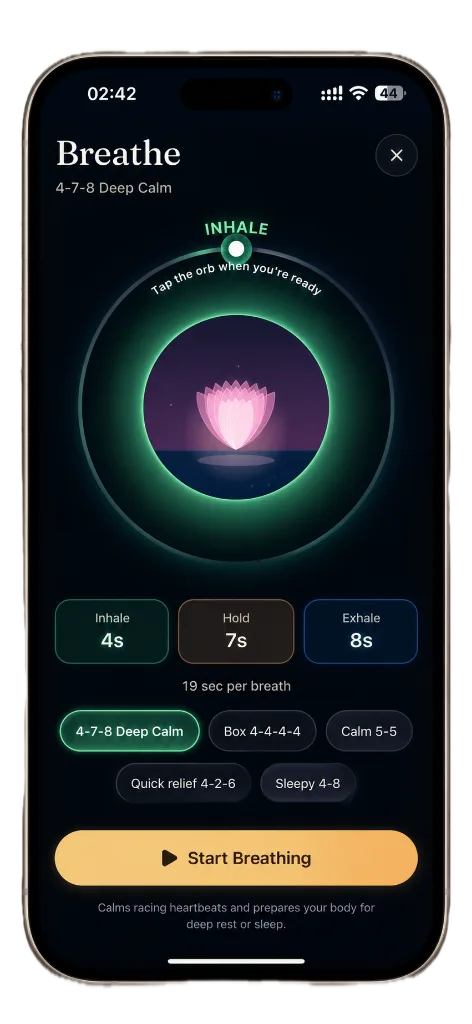
A longer exhale is the part most people find calming. On night 3, breathe in for four and out for six. On night 4, try 4-7-8 breathing: in for four, hold for seven, out for eight. If seven feels strained, use a shorter shape such as 3-5-6. Three rounds are plenty.
Nights 5 to 7: make it yours
By now you will know what suits you. Some people prefer the simplicity of 5-5. Others like the structure of 4-7-8. You can add a low rain sound from the free sleep sounds mixer on night 6. On night 7, drop the counting altogether and just follow your breath.
You can use our breathing exercise timer on any night if you would like the pace shown visually.
If a night goes badly
It will, sometimes. You might feel breathless, or your mind may race, or you may fall asleep in the middle of the exercise. All of that is fine.
- Light-headed or tingly? Breathe smaller and slower, or stop and breathe normally.
- Counting makes you tense? Drop the numbers and just make each out-breath slightly longer.
- Mind racing? Try cognitive shuffling afterwards.
After the seven nights
Keep the pattern you liked best as a regular part of your evening. Breathing is one small piece of a bedtime routine, alongside dim light, a steady schedule and screens away. See wind down before bed for the full picture.
Anyone with asthma, a heart or lung condition, or who is pregnant should check with their doctor before trying breath holds. If you are still sleeping badly after a few weeks, a doctor or sleep specialist can look for causes.
Common questions
Can breathing exercises help you fall asleep?
They can help you relax, which makes it easier for sleep to arrive. They are not a guaranteed sleep trick, and they work best as part of a regular bedtime routine.
Should I do breathing exercises in bed or before bed?
Either works. Many people do a few minutes sitting on the edge of the bed to settle, then lie down and let their breathing return to normal.
What if counting keeps me awake?
Choose a gentler option with no holds, such as calm 5-5 breathing, or just focus on making each out-breath slightly longer. If counting feels like a task, drop it.
Try this in Aama
Breathing exercises, sleep sounds and a mood journal, in one quiet app for your phone. No ads inside.
Feeling unsafe? Get help now
Related guides
4-7-8 breathing: a simple step-by-step guide
Learn the 4-7-8 breathing pattern in about a minute, with clear steps, common mistakes and when to stop.
Wind down before bed: a 20-minute routine
A short, realistic evening routine to help your mind unwind before sleep, with sound tips and what to do if you can't sleep.
Cognitive shuffling: a simple mental trick for falling asleep
What cognitive shuffling is, how to do it step by step, two easy versions, and an honest look at what we know about whether it helps you fall asleep.
Rain sounds for sleep: do they work, and how to use them
An honest look at whether rain sounds help you sleep, how to choose and mix sounds, how loud they should be, and how to use a sleep timer safely.